
The aim of the ‘Dehalogenation’ research project is to develop a process for decontaminating category IV waste wood, with a focus on the removal of organochlorine compounds (e.g. PCP, lindane, DDT, PCB), as a preliminary step towards material utilisation.
The aim is to establish a process chain that allows waste wood to be re-evaluated as a recyclable material after decontamination and defibration. This is based on the decomposition of waste wood using the steam explosion process, in which the target compounds are dechlorinated by adding appropriate additives beforehand in order to mineralise the organically bound chlorine into chloride. Compared to the polychlorinated starting materials, the dechlorinated organic compounds are significantly less toxic and much more volatile, which allows them to be separated with the vapour phase during the expansion step. Pre-introduced reaction partners are completely converted into non-critical products. The necessary catalysts and their degradation products are subsequently separated or are acceptable in terms of their remaining in the wood fibre.
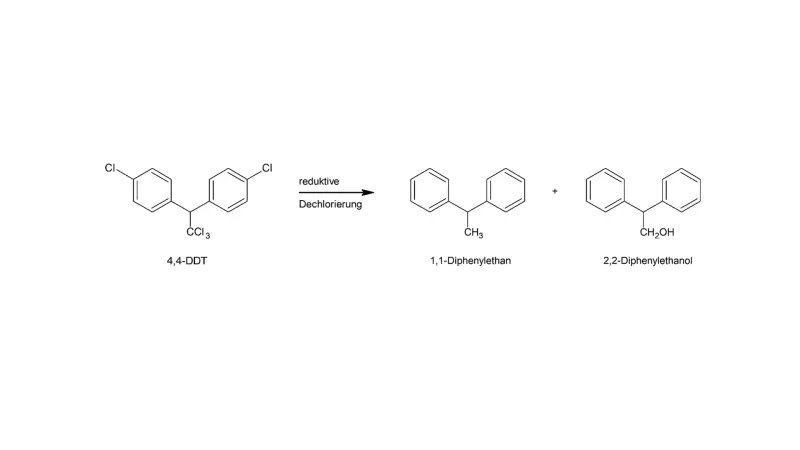
In studies conducted to date on organochlorine compounds, rapid and complete dechlorination has in some cases already been achieved at room temperature (see sum reaction for the example of DDT in the figure). This results in the rapid substitution of aliphatically and aromatically bound chlorine atoms with hydrogen atoms and OH groups. The dechlorination of other active substances and the transfer of the reaction to contaminated waste wood are the subject of current work.
A major challenge is the need for a particulate catalyst that must be sufficiently well distributed throughout the wood. Furthermore, unfavourable interactions between the reagents used and wood constituents as well as other wood preservatives and flame retardants, especially those based on chromium, fluoride or phosphate, are to be expected.
The project with the funding code 49MF250009 is funded by the Federal Ministry for Economic Affairs and Climate Protection as part of the INNO-KOM module ‘Market-oriented research and development’ funding guideline.
Contact person at the IHD:
Dr Martin Fischer, martin.fischer@ihd-dresden.de