
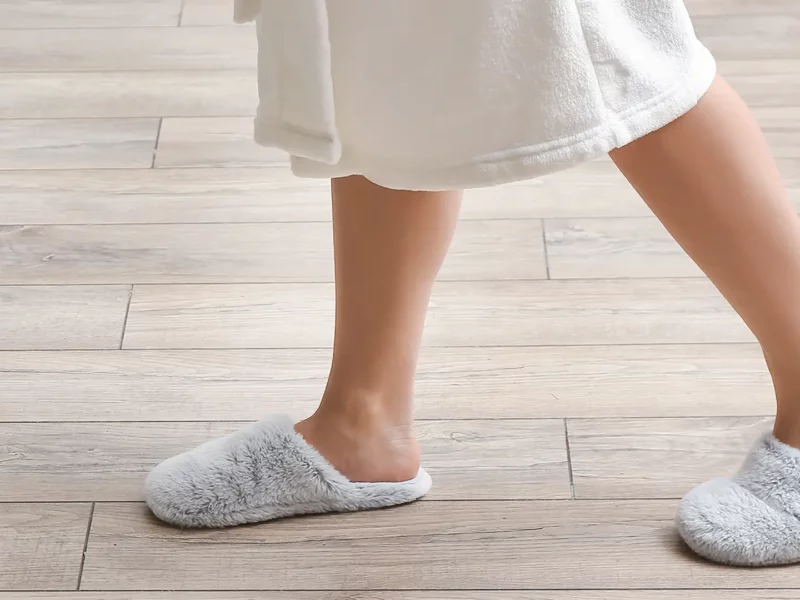
Almost everyone is familiar with the phenomenon of a small spark jumping when walking across a floor covering (e.g. laminate, MMF and elastic floor coverings) and then touching a door handle.
This is an electrostatic discharge. It occurs when electrical charges are formed by friction and separation of two materials. The strength of this charge depends on numerous factors, such as the materials of the friction partners, the gait, clothing or climatic conditions. Such charging can be significantly increased, especially in dry indoor air, as is often the case in winter. Under unfavourable conditions, people can become charged with voltages of up to 25 kV. When discharged, this is perceived as an unpleasant or even painful electric shock.
Such discharges are not only disruptive, but also relevant to safety, especially in public buildings, laboratories or industrial areas where sensitive equipment is used. Conventional floor coverings made of non-conductive materials have an electrically insulating effect and thus prevent the dissipation of electrostatic charges. To reduce electrostatic effects, conductive additives such as industrial carbon black or chemical antistatic agents have been used to date. However, these lose their effectiveness over time due to wear, migration or chemical changes.
This is where a new research project by the IHD comes in, which has been running since January 2025 as part of the BMWE funding guideline INNO-KOM (Module MF). The aim is to develop suitable coating systems in which copper particles are chemically integrated into polyurethane (PU) binders. Due to its high electrical conductivity and antimicrobial effect, copper enables the production of coatings that are permanently antistatic and hygienically effective at the same time.
The targeted functional modification of the binders – conventional, bio-based or non-isocyanate-based (NIPU) – is intended to create stable chemical bonds between copper and the polymer matrix. The aim is to achieve an even distribution of copper and a surface resistance of less than 10⁹ Ω. At the same time, drying and cross-linking processes (IR, UV, UV-LED, excimer) are being optimised to improve adhesion, gloss and surface quality.
With this project, the IHD is making an important contribution to the development of durable, multifunctional and environmentally friendly coating systems for floor coverings that are both antistatic and antimicrobial.
Contact persons for the project:
Lisa Kleber (lisa.kleber@ihd-dresden.de)
Petra Schulz (petra.schulz@ihd-dresden.de)