
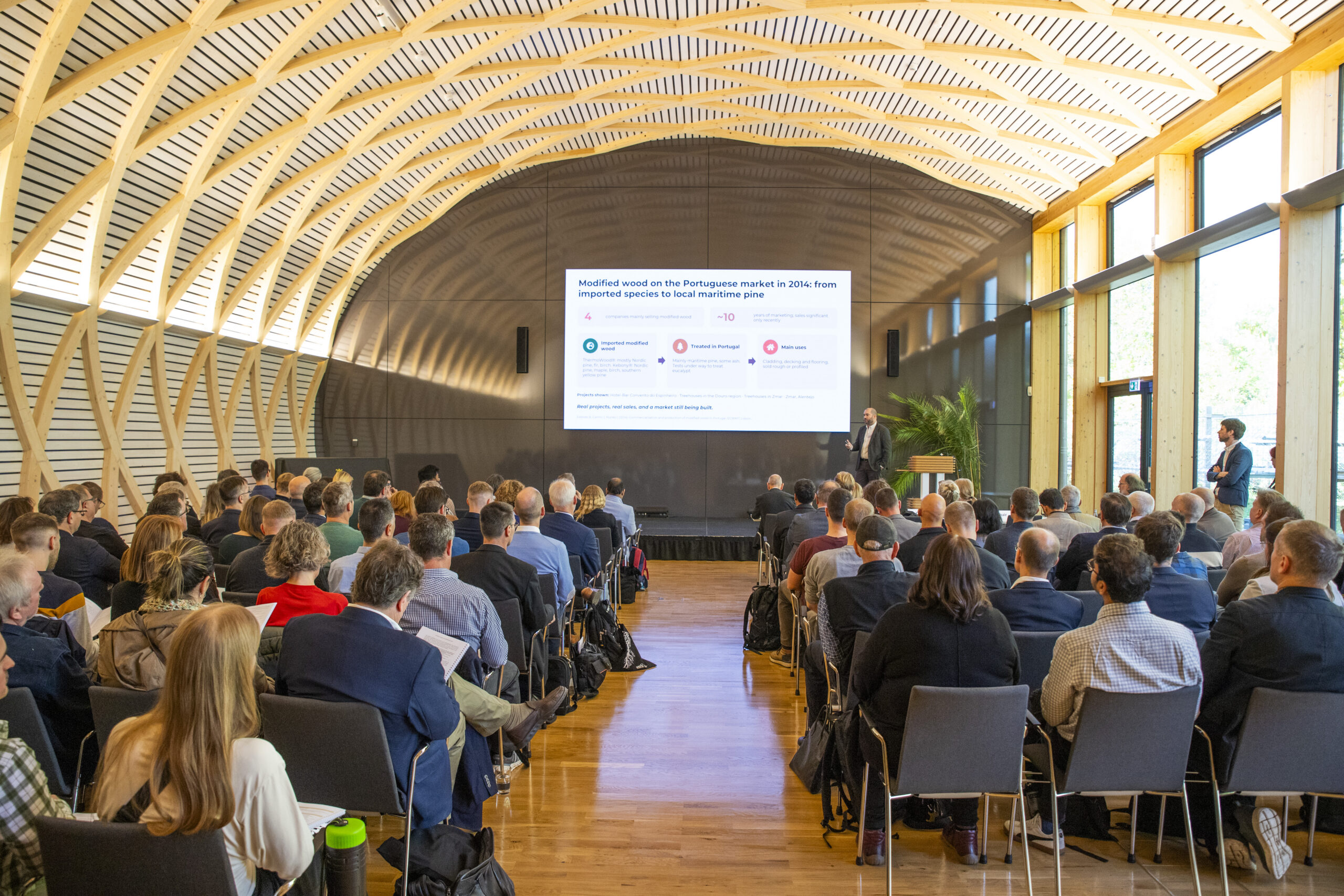
12th European Conference on Wood Modification in Dresden
On 26 and 27 October 2026, the Institut für Holztechnologie Dresden hosted the 12th European Conference on Wood Modification (ECWM12). The conference brought 130 scientists and experts from research and industry, representing 30 predominantly European countries as well as Argentina, Brazil, South Africa and Australia, to Dresden to present research findings, discuss current developments and foster professional contacts. The varied programme comprised 72 technical presentations and offered insights into new technologies, innovative applications and the sector’s current challenges.
Wood modification opens up new prospects
Wood is a versatile and renewable material, but its natural properties can limit certain applications. Through thermal, chemical or other modification processes, it is possible, for example, to improve its resistance, dimensional stability and resistance to moisture and biological degradation. This creates new opportunities for the use of wood, for example in construction, for façades, windows or other technically sophisticated products.
The two-day conference programme demonstrated just how diverse the research approaches have become. In addition to thermal and chemical wood modification, the focus was on new processes based on bio-based substances, innovative impregnation technologies, and the development and assessment of modified wood products.
From sustainable materials to unusual applications
Several research papers highlighted that wood modification extends far beyond traditional areas of application. For example, research was conducted into whether modified wood could be suitable as a construction material for satellites in the future. Other studies focused on the use of thermally modified ash for window frames or the development of bio-based materials from modified wood.
The circular economy also featured prominently in the scientific programme. Topics included how the service life of timber products can be extended and the contribution that modified timber can make to resource-efficient material use. The approaches presented highlighted both new technological possibilities and the challenges involved in transferring scientific findings into industrial practice.
Another area of focus concerned the reaction to fire of modified woods. Among other things, research was presented on new flame-retardant processes, wood mineralisation, and the targeted treatment and charring of wood surfaces.
IHD represented with its own research contributions
The IHD also contributed several scientific papers to the conference programme. A key focus was on the development of new methods for the rapid and reliable characterisation and quality assessment of thermally modified timber. In the ‘TMT-Fingerprint’ project, various short-term tests are combined to enable the degree of modification and key performance properties – in particular, biological resistance – to be better evaluated and predicted in future. Beyond that, the material’s characteristic ‘fingerprint’ is intended to enable TMT products to be identified retrospectively.
Further work focused on spectroscopic methods for assessment of the intensity of treatment, as well as innovative modification processes based on high-frequency dielectric heating (patent pending). Beyond that, studies on extending the service life of wooden shingles through various modification processes were presented.
International Exchange and Cross-Linking
In addition to the technical presentations, numerous poster presentations provided an opportunity for in-depth discussion of current research. Direct exchange between scientists, developers and industry representatives played a central role in this. Even outside the presentation programme, there were ample opportunities to maintain existing contacts, initiate new collaborations and discuss joint research questions. By hosting ECWM12, the IHD underlined its role as an internationally networked research centre. The conference revealed the potential inherent in the targeted further development of wood as a raw and engineering material, and emphasised the importance of collaboration between research and industry in transferring innovative technologies into marketable applications.