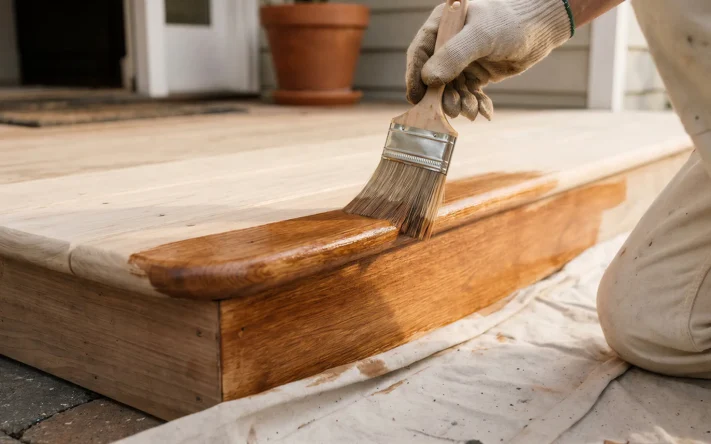
When exposed to sunlight, coatings lose their lustre over time, turn yellow or develop scratches. This reduces their protective effect. In the case of wood surfaces with transparent coatings, the substrate itself may also be damaged. In the COVABLOC research project, the Institut für Holztechnologie Dresden is investigating how light protection can be improved using novel additives.
To achieve comprehensive light protection, two classes of additives are often combined: UV absorbers absorb the harmful radiation and release it as harmless heat; light stabilisers based on sterically hindered amines (Hindered Amine Light Stabilizers), on the other hand, trap reactive radicals and thereby interrupt damaging chain reactions.
Long-term protection can be compromised by the migration and leaching of the additives; for this reason, state-of-the-art techniques involve modifying them through oligomerisation or by attaching anchoring molecular groups to form larger – and thus less mobile – molecules. However, these modifications dilute the light protection effect, as the groups do not contribute to light protection but do increase the molecular weight of the additives.
COVABLOC is pursuing an approach that combines both protective functions within a single molecule via covalent – that is, permanent chemical bonds – whilst replacing the previously used anchoring groups. Furthermore, the direct proximity of the two active mechanisms allows them to interact more effectively in a synergistic manner. Research is being conducted to determine whether this approach can achieve comparable or better light protection at weaker usage levels.
For a targeted comparison, additives with a similar structure—each containing only one class of additive—are also being produced and incorporated into formulations as so-called ‘blends’. This allows the actual effect of the covalent, bimodal linkage on the UV protection effect to be investigated in comparison with a purely physical mixture of both components.
The new additives are being synthesised, characterised and tested in coatings. Weathering tests are intended to show how colour, gloss, crack propagation and additive loss develop in comparison with reference systems.
COVABLOC is funded by the Federal Ministry for Economic Affairs and Energy under the INNO-KOM programme, module ‘Market-Oriented Research and Development’ (funding code 49MF260017). The term of the project is from September 2026 to February 2029.